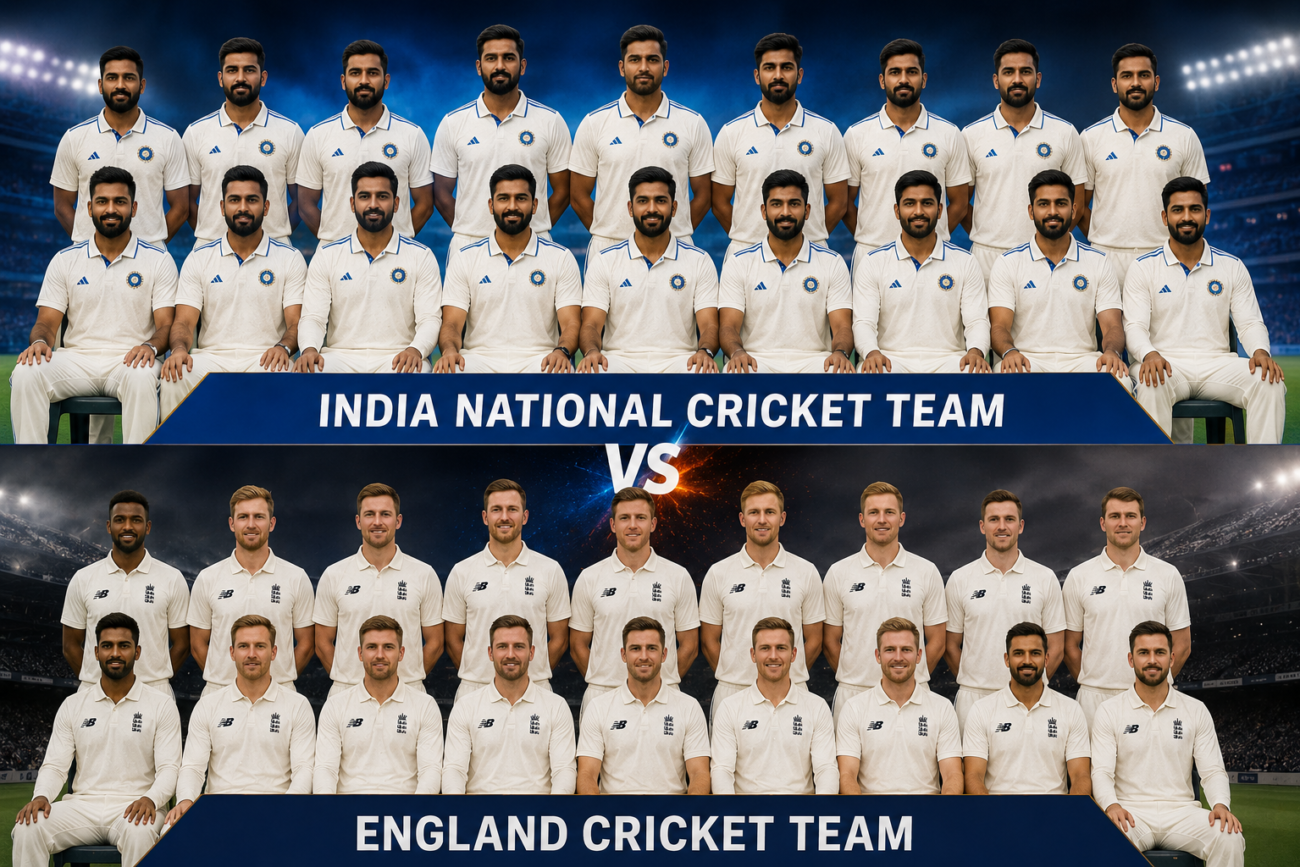
The India National Cricket Team Vs England Cricket Team Match Scorecard 1st Test tells a story far bigger than numbers on a scoreboard. Played in Hyderabad during England’s 2024 tour of India, this Test became one of the most remarkable overseas victories of the Ben Stokes–Brendon McCullum era. England recovered from a massive first-innings deficit, produced one of the greatest fourth-innings bowling performances seen in India, and stunned a side that had dominated Test cricket at home for more than a decade.
For cricket fans, historians, and analysts alike, this match remains a fascinating case study in resilience, tactical courage, and the unpredictability of Test cricket.
India National Cricket Team Vs England Cricket Team Match Scorecard 1st Test
Before diving into the analysis, here is the complete match summary.
| Match | 1st Test |
|---|---|
| Venue | Rajiv Gandhi International Stadium, Hyderabad |
| Dates | January 25–28, 2024 |
| Toss | England won and elected to bat |
| Result | England won by 28 runs |
| Player of the Match | Ollie Pope |
England recovered from a 190-run first-innings deficit to secure a memorable victory. Such comebacks are rare in Test cricket, especially in Indian conditions where teams batting last often struggle against spin.
Match Score Summary
| Team | 1st Innings | 2nd Innings |
| England | 246 | 420 |
| India | 436 | 202 |
England won by 28 runs.
The scorecard reveals the extraordinary nature of the contest. India appeared in complete control after the first innings, but the final result tells a different story.
How India Took Control During the First Two Days
For most of the opening half of the Test, India looked destined for a comfortable victory.
England’s first innings ended at 246. Ben Stokes was the standout performer with 70, while India’s spin trio controlled proceedings effectively. Ravichandran Ashwin and Ravindra Jadeja shared six wickets, consistently exploiting the surface.
England First Innings Key Performers
| England Batter | Runs |
| Ben Stokes | 70 |
| Jonny Bairstow | 37 |
| Ben Duckett | 35 |
India Bowling Figures
| Bowler | Wickets |
| Ravichandran Ashwin | 3 |
| Ravindra Jadeja | 3 |
| Axar Patel | 2 |
| Jasprit Bumrah | 2 |
India then responded with authority.
Yashasvi Jaiswal played with freedom, KL Rahul produced one of his most fluent Test innings, and Ravindra Jadeja contributed a valuable 87. The batting unit collectively pushed India to 436 and established a commanding lead of 190 runs.
At this stage, most observers believed the contest was effectively over.
India’s Dominant First Innings Explained
A closer look at India’s batting performance highlights why the match seemed one-sided.
Top India Batters – First Innings
| Batter | Runs |
| Ravindra Jadeja | 87 |
| KL Rahul | 86 |
| Yashasvi Jaiswal | 80 |
| Axar Patel | 44 |
India’s batting approach was measured rather than aggressive. They absorbed pressure, rotated strike, and gradually wore down England’s attack.
What made the innings particularly impressive was the way India neutralized England’s spin resources. Tom Hartley, making his Test debut, initially struggled and leaked runs.
The massive lead reinforced a long-standing belief in world cricket: if India gain a significant first-innings advantage at home, they rarely lose.
Yet Test cricket often rewards patience more than momentum.
Ollie Pope’s Masterclass That Changed Everything
Every great Test match has one innings that defines it.
In Hyderabad, that innings belonged to Ollie Pope.
His 196 ranks among the finest overseas Test innings by an English batter in India. While wickets fell around him, Pope adapted brilliantly to the turning pitch and refused to abandon England’s attacking philosophy.
England Second Innings Leading Run Scorers
| Batter | Runs |
| Ollie Pope | 196 |
| Ben Duckett | 47 |
| Rehan Ahmed | 28 |
| Ben Foakes | 34 |
Unlike conventional defensive innings on spinning tracks, Pope used sweeps, reverse sweeps, and innovative placement to disrupt India’s bowlers.
What made the knock historically significant was the context:
- England were trailing by 190 runs.
- India possessed three world-class spinners.
- The pitch was increasingly difficult for batting.
- England needed a competitive target merely to stay alive.
Instead, Pope delivered a near double-century that transformed the match.
Many former cricketers later described the innings as one of the greatest by an overseas batter in India in the modern era.
The Target of 231: Why It Was More Dangerous Than It Looked
England’s second innings total of 420 set India a target of 231.
On paper, chasing 231 may not appear daunting.
In India, however, fourth-innings chases are rarely straightforward when spin dominates proceedings.
Fourth Innings Equation
| Requirement | Value |
| Target | 231 |
| India Start | Strong Position |
| Final Score | 202 |
| Margin | 28 Runs |
England understood that pressure would be their greatest ally.
Every wicket increased the difficulty of scoring. Every dot ball amplified tension. As the chase progressed, India’s batting lineup began to show signs of uncertainty.
England’s field placements became increasingly aggressive. Ben Stokes rotated bowlers cleverly and ensured no partnership settled.
The target itself was not enormous.
The conditions made it feel much larger.
Tom Hartley’s Dream Debut and Match-Winning Spell
If Ollie Pope revived England’s hopes, Tom Hartley completed the job.
The left-arm spinner endured a difficult first innings, conceding runs and appearing vulnerable. Many debutants would have lost confidence.
Hartley did the opposite.
Tom Hartley Second Innings Bowling
| Bowler | Wickets | Runs |
| Tom Hartley | 7 | 62 |
Hartley’s seven-wicket haul completely altered the contest.
His victims included some of India’s most important batters. More importantly, he consistently challenged both edges of the bat and exploited rough patches created by the fast bowlers.
The performance stands among the most memorable debut bowling displays by an English spinner overseas.
For a player who had been heavily attacked in the first innings, the turnaround was extraordinary.
Turning Points That Decided the Match
Several moments shifted momentum dramatically.
Major Turning Points
| Moment | Impact |
| Pope reaches century | England rebuild innings |
| Pope crosses 150 | India lose control |
| England cross 400 | Match becomes balanced |
| Early Indian wickets in chase | Pressure rises |
| Hartley’s middle-order breakthroughs | England take control |
| Ashwin dismissal | Final momentum swing |
The dismissal of Ravichandran Ashwin proved especially important.
India still had hopes when Ashwin and KS Bharat were resisting. Once that partnership ended, England sensed victory.
These moments highlight why Test cricket remains the sport’s ultimate examination of patience, adaptability, and mental strength.
Historical Significance of England’s Victory
England’s win was about more than a single Test.
For years, visiting teams had struggled to defeat India in India. Home conditions, world-class spinners, and batting depth made India almost unbeatable.
Historical Context
| Achievement | Significance |
| England won after trailing by 190 | Rare Test comeback |
| Victory in India | One of cricket’s toughest challenges |
| Pope’s 196 | Landmark overseas innings |
| Hartley’s debut seven-for | Historic debut performance |
England’s victory demonstrated that modern Test cricket strategies could succeed even in traditionally difficult conditions.
It also reinforced the confidence generated during the Stokes-McCullum era.
Many commentators described it as England’s finest overseas Test victory under the current leadership group.
Records and Milestones From the Hyderabad Test
The match produced numerous memorable milestones.
Key Records Table
| Record | Achievement |
| Player of the Match | Ollie Pope |
| Highest Individual Score | Ollie Pope – 196 |
| Best Match Bowling Story | Tom Hartley’s 7-wicket haul |
| Largest Contribution to England Recovery | Pope’s second innings |
| Winning Margin | 28 Runs |
| Venue | Hyderabad |
Statistics alone do not capture the drama.
What makes these numbers significant is the context in which they were achieved. Pope’s innings came under immense pressure. Hartley’s spell arrived after a difficult debut innings. England’s victory came against a team renowned for home dominance.
That combination elevates the match into modern Test cricket folklore.
Tactical Lessons From Both Teams
One reason the India National Cricket Team Vs England Cricket Team Match Scorecard 1st Test remains fascinating is the tactical debate it generated.
England embraced risk.
Their batting remained proactive despite challenging conditions. Pope’s approach demonstrated how calculated aggression can disrupt elite spin bowling.
India, meanwhile, may have become slightly conservative once they established a large lead.
Several analysts argued that India allowed England too many scoring opportunities during Pope’s innings. Others pointed to missed chances and periods where pressure was not sustained.
The Test highlighted a broader trend in modern cricket.
Teams increasingly seek proactive methods rather than relying solely on traditional defensive approaches.
England’s victory became a practical example of how intent, belief, and tactical flexibility can reshape a match that appears lost.
Why Cricket Fans Still Talk About This Test
Years from now, cricket supporters may not remember every run scored.
They will remember the story.
A team trailing by 190 runs.
An innings of 196 under immense pressure.
A debut spinner recovering from punishment to claim seven wickets.
A stunned home crowd witnessing one of the most unlikely Test turnarounds in recent memory.
The India National Cricket Team Vs England Cricket Team Match Scorecard 1st Test remains a reminder that Test cricket rewards resilience more than reputation.
England refused to accept defeat when the match seemed beyond reach. India discovered how quickly momentum can change in the longest format of the game.
That is precisely why this Test continues to be discussed among the most memorable India-England encounters of the modern era.
Conclusion
The India National Cricket Team Vs England Cricket Team Match Scorecard 1st Test reflects one of the most dramatic contests in recent Test cricket history. England’s 28-run victory in Hyderabad was built on Ollie Pope’s magnificent 196 and Tom Hartley’s stunning seven-wicket spell. Despite India securing a 190-run first-innings lead, England produced a remarkable comeback that challenged conventional expectations about winning in Indian conditions. Beyond the statistics, the match showcased courage, tactical innovation, and the enduring beauty of Test cricket, ensuring its place among the most memorable chapters in the rivalry between these two cricketing giants.
FAQs
Who won the India vs England 1st Test in Hyderabad in 2024?
England won the match by 28 runs. After trailing by 190 runs on first innings, England produced a remarkable comeback through Ollie Pope’s 196 and Tom Hartley’s seven-wicket haul. The victory was widely regarded as one of England’s finest overseas Test wins of the modern era because it came against a dominant Indian side in home conditions.
Who was the Player of the Match in the 1st Test between India and England?
Ollie Pope received the Player of the Match award. His second-innings score of 196 transformed the contest. England were in danger of suffering a heavy defeat, but Pope’s exceptional innings helped his team post 420 and set India a challenging fourth-innings target.
What were the final scores in the India vs England 1st Test?
England scored 246 and 420 in their two innings. India replied with 436 and 202. England therefore won by 28 runs. The scoreline is notable because India held a huge first-innings lead but could not complete the chase in the fourth innings.
Why was Ollie Pope’s 196 considered special?
Pope’s innings came on a turning surface against one of the world’s strongest spin attacks. He used innovative shot-making and excellent game awareness to score 196 when England desperately needed a major contribution. Many experts regard it as one of the finest Test innings by an overseas batter in India.
How many wickets did Tom Hartley take in the match?
Tom Hartley claimed seven wickets in India’s second innings. His performance was remarkable because he had endured a difficult first innings and was playing his debut Test. His spell became the defining bowling performance of the match and played a decisive role in England’s victory.
What made this Test historically significant?
The match was significant because England overcame a massive 190-run first-innings deficit to win in India. Such comebacks are rare in Test cricket, particularly against India at home. The result demonstrated England’s resilience and reinforced the effectiveness of their aggressive Test philosophy.
